Neighbouring places now merge
Next-door places with the same conditions are now solved as one. Time skips run about 1.3 times faster, and places split again when their conditions drift apart.
A planet-evolution game for Windows · In development
Pick a world and watch it form. Take over once it has water. Tune its star, air and oceans until it can host life. Then follow that life, or drop to the scale of a single cell and steer one lineage yourself.
Every system rests on a published model: energy balance, the carbon cycle, plate motion, population genetics. The equations keep their shape so a turn still reads in seconds.
Each world follows its own physics. Life does not copy Earth. It evolves under the same laws, so every planet grows its own tree of life.
Your cell eats what the planet makes. Your lineage changes the air the planet breathes.
Every stage runs on its own. Taking control of a cell is a choice, never a gate.
Plates split continents, raise mountains and open seaways. That decides where species live and when they split.
You win at planet scale: the air drifts out of chemical balance because something lives there.
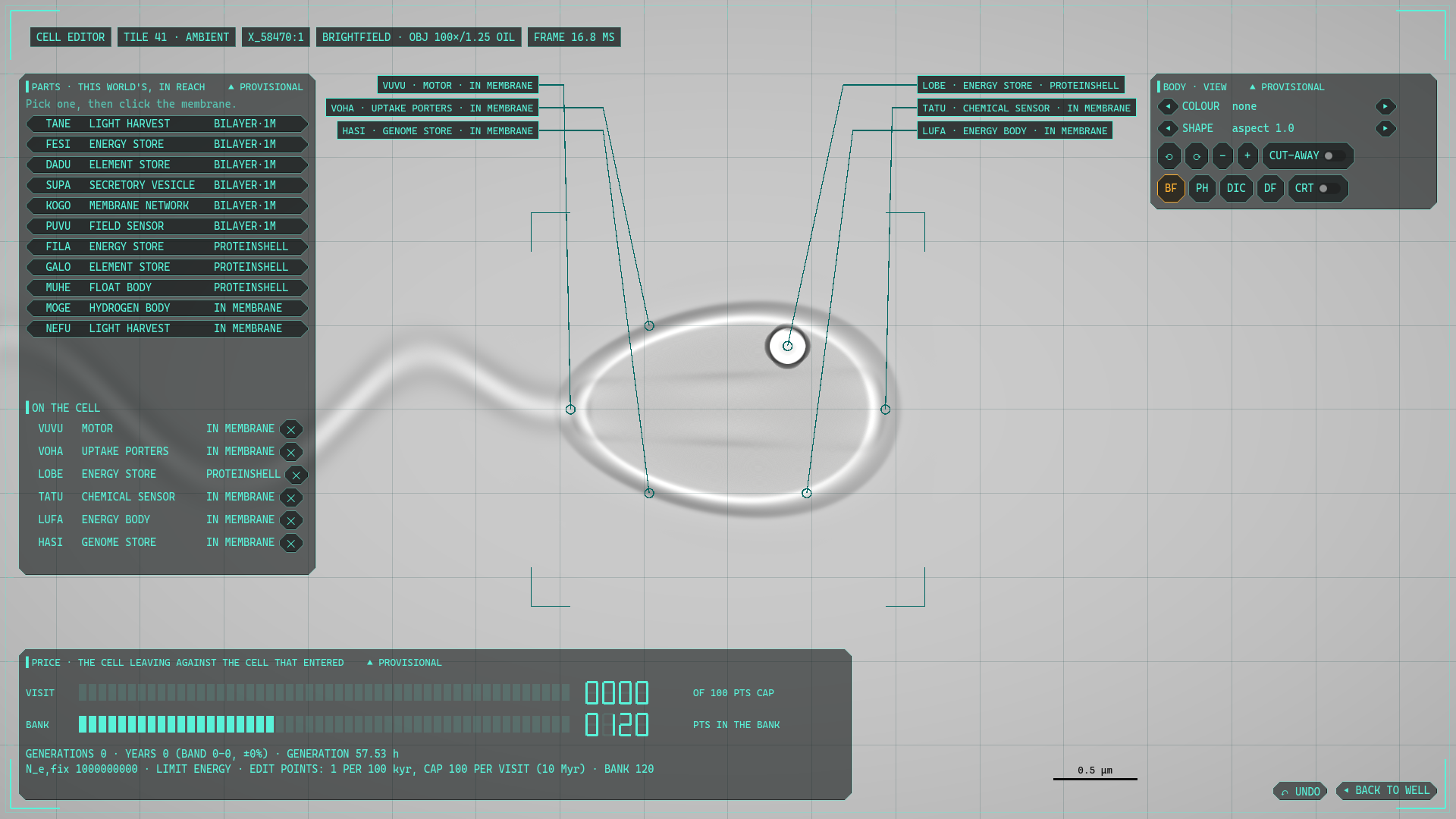
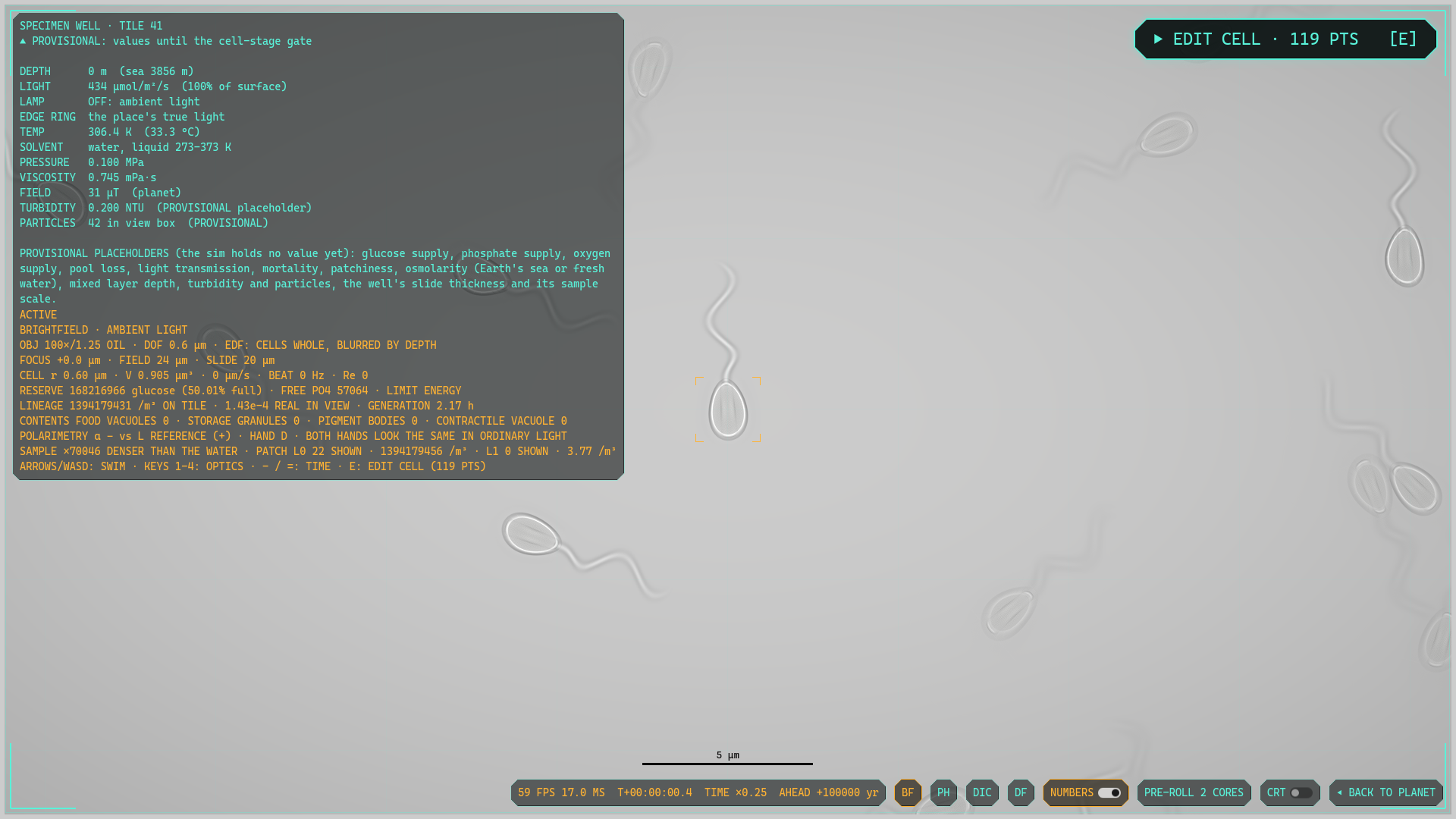
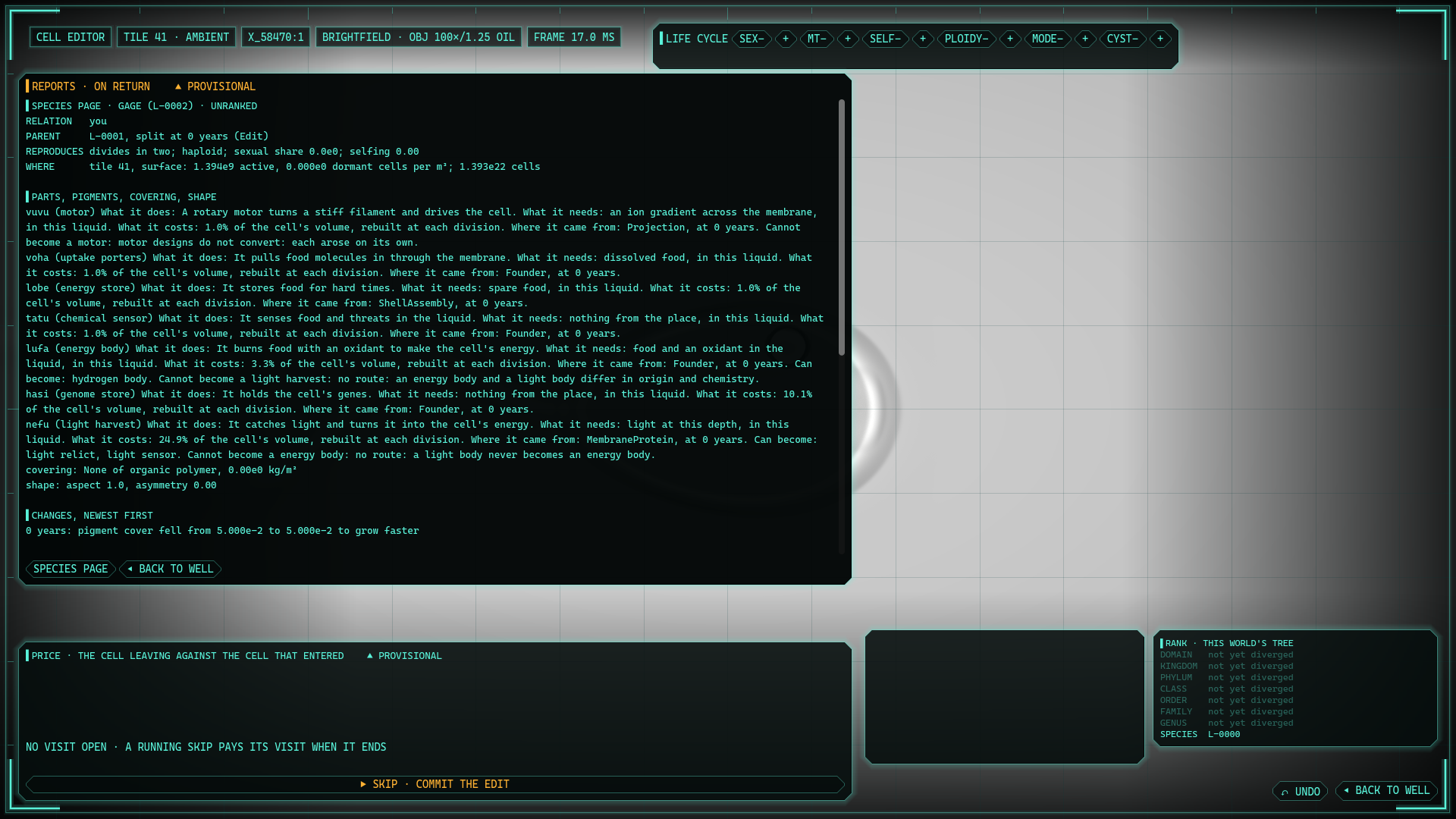
Each milestone ends playable. Dates are not promised: this is a one-person project and the science comes first.
| # | Status | Milestone |
|---|---|---|
| M0 | Done | ToolchainGodot 4.7 for the 3D view, Rust for every line of simulation. |
| M1 | Done | Planet sandboxA planet with climate, starlight, CO₂ and volcanoes that you can look at and poke. |
| M2 | Mostly done | Planet formation and game shellPick a world, watch it form, take over once it has water. |
| M3 | In progress | Plates, ocean, water and weatherContinents, mountains, rivers, ice and weather, and a planet that looks like a photograph from orbit. The biggest milestone. It continues after the life prototype. |
| M4-5 | In progress | Life layer and cell stageLife from each world's chemistry. Edit your cell, skip ahead thousands of years and see what evolution did with it. |
| M6 | Planned | Species and evolutionSpecies spread, compete, split and die out across the whole planet. |
| M7 | Planned | Neighbours, stars and catastrophesMoons, sibling planets, flares, impacts, and stars that age. |
| M8 | Planned | PlantsLand colonised and greening you can see from orbit. Under a red dwarf, plants may come out near black. |
| M9 | Planned | Other chemistriesLife in methane seas and other liquids, with its own slower clock. |
| M10 | Planned | CreaturesBodies, gaits and small brains, limited by gravity and air. |
| M11 | Planned | Full game loopShocks, resilience and an end screen. Late in the game, the star can swell into a red giant. |
| M12 | Planned | ReleaseTutorial, an in-game encyclopedia with sources, and sound. |
Made in the open: what changed, and what went wrong.
Next-door places with the same conditions are now solved as one. Time skips run about 1.3 times faster, and places split again when their conditions drift apart.
Three in four ecology solves used to stop before they had an answer. The rewrite makes them converge. It also showed a bug where one lineage took every place on the planet. It is fixed.
The simulation's maths are now pure Rust, so the same seed gives the same world bit for bit on any PC and any Windows update.
Every mechanism in the game is tagged with how sure science is about it.
Textbook result with many independent lines of evidence.
Shown by published models. Plausible, but the numbers are uncertain.
Published but disputed. Shown in the game with a "contested" badge.
A game assumption, used where science has no answer yet.